Many adults naturally ask children a lot of questions: “What color is that?” “What do you want?” “Can you say ___?” Questions can be useful. But when every interaction feels like a quiz, a child may have fewer chances to simply notice, enjoy, and share something with you.
What is declarative language?
Declarative language is a way of talking that shares an observation, thought, or feeling without requiring the other person to answer or do something. It can make an interaction feel more open. The goal is not to eliminate questions or follow a script; it is to create a little more space for connection and a child’s own response.
Try a small shift
Instead of “What are you building?” you might say, “That tower is getting tall.”
Instead of “Can you give the bear a cookie?” try, “The bear looks hungry.”
Instead of “What do you see?” you could say, “I notice a tiny bird on the branch.”
Instead of “Say ‘open’” you might model, “The box is tricky. I wonder what could help.”
Then pause. Your child might answer with speech, a gesture, a look, an AAC message, an action, or no response at all. A comment is not a hidden test. You can enjoy the moment without waiting for a particular performance.
Follow your child’s lead
Use comments that match what your child is already interested in. If they are lining up toy animals, you could notice, “The penguins are all in a row.” If they are watching a favorite show, you could share, “That character looks surprised.” These moments can give children language to hear while keeping their interests at the center.
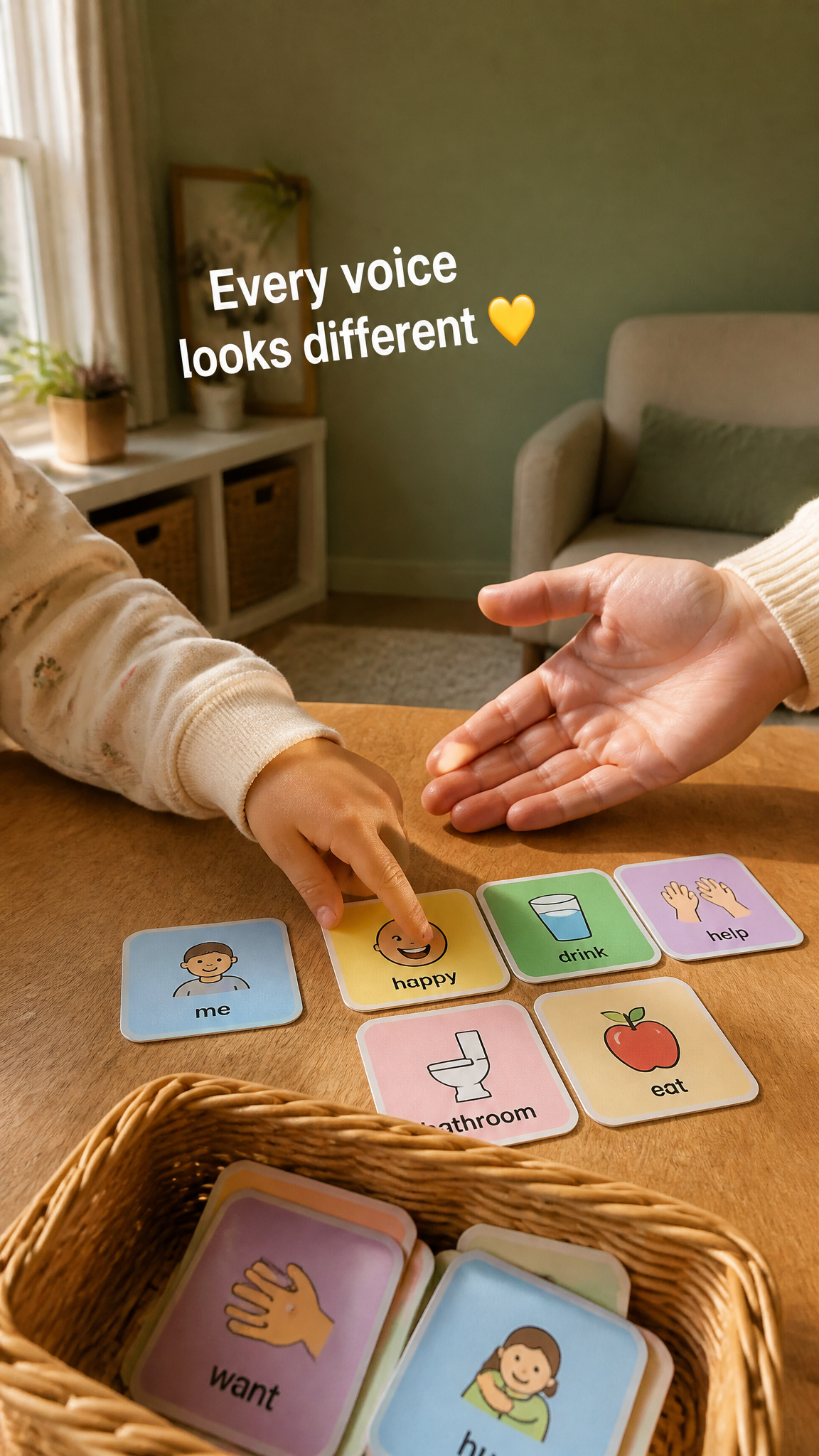
If your child uses AAC, sign, or gestures, keep those ways of communicating available and respond to them. You can model language on a communication device when it fits, without requiring your child to copy you. A child’s communication does not need to be spoken to count.
Keep it practical
Try one routine—snack, bath, getting dressed, or play—and replace a few rapid-fire questions with observations. You do not need to narrate every minute. Natural pauses are allowed; silence is not a failed therapy session.
Declarative comments are one tool for making interactions more responsive. They are not a treatment plan by themselves, and direct language still matters for safety, clear boundaries, and everyday logistics. Notice what helps your child feel more comfortable and connected.
Bite-Sized Beginnings supports families with practical, child-centered communication strategies. Visit bitesizedkids.com to learn about pediatric speech-language services in Naperville, Illinois.
Helpful reading
ASHA: Family-Centered Care and Coaching in Early Intervention — https://www.asha.org/practice/early-intervention-provider-support/family-centered-care-and-coaching-in-early-intervention/
ASHA: Augmentative and Alternative Communication in Early Intervention — https://www.asha.org/practice/early-intervention-provider-support/augmentative-and-alternative-communication-in-early-intervention/
A next step, if you need one
Support that makes room for the whole child.
Bite-Sized Beginnings offers neuroaffirming pediatric speech-language services in Naperville, Illinois.